Before in that location were synthetic fabrics, earlier Gore-Tex and "weatherproof breathability," there was thick cotton and a can of wax. Early sailors realized that wet sails caught the current of air better than dry sails, just wet sails were too heavy and slowed the ships down. The solution was rubbing oil into the sailcloths, making them more efficient and also h2o repellent so they stayed light in the rain. The sailors started cutting jackets out of the oiled sailcloth for themselves, wearing early editions of the rain jacket, just these primitive designs, made with linseed oil, became potent in the cold and faded in color. Then, in the early on 20th century, manufacturers developed a process for impregnating cotton wool with methane series wax. The new material made for flexible, warm, durable and waterproof clothing that was chop-chop adopted past soldiers, outdoorsmen and sailors.
Since then a slew of constructed, breathable and waterproof fabrics take been developed — and used in those lightweight Northward Face jackets everybody wears. Simply a few companies have stuck with waxed cotton wool, which remains much more suited to workwear and carries the expect and history of a existent outdoorsman; don't wait the paper-thin liner of your standard synthetic null-up to survive a stray edge when you're cutting downwardly a tree.
One of those companies is Filson, which got its first in Seattle in 1897 outfitting prospectors on their way to the Klondike Gold Rush. The company still offers waxed cotton jackets for their customers — their flagship jackets are fabricated of heavy tin cloth, named from when can was the most resistant, commonly used metallic. A couple of years ago, we met with Michael Skauge — then the retail managing director of Filson'south New York operations — to larn how to re-wax a heavy cotton jacket. Follow along below.
Clean and Prep Your Jacket
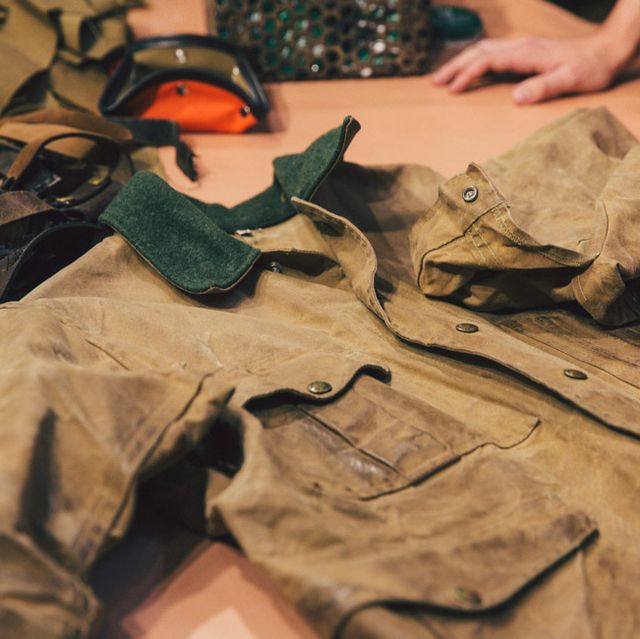
You tin tell a jacket needs to be re-waxed by its appearance. The areas where the wax has been worn out volition appear lighter than the oily, nighttime patches around seams and indentations. Presumably, if you need to re-wax your jacket, y'all've been wearing information technology exterior, then y'all may desire to clean it earlier you re-wax it. However, Skauge warns that you normally shouldn't try to clean the jacket because "spot cleaning will lighten certain areas as the wax is washed out."
So if y'all want to remove the crud and odour afterwards a flavour of use, the best movement is to soak the entire jacket in common cold water or hose it off completely. Don't use any soaps or detergents. This isn't your t-shirt; machine washing a wax jacket ruins the material.
Employ the Wax
Once the jacket is dry out, lay the jacket out on a table and grab a canister of paraffin wax or soy wax (soy wax is typically used on lighter jackets); wax jackets are normally sold with the correct wax. Some guides volition tell you to heat the wax and use a paintbrush to castor it on, but this is a jacket, non a paint-by-numbers. Skauge suggests simply using your hands to piece of work that wax into the jacket.
"The estrus from your hand helps loosen upwardly the wax. Alkane melts at almost 100 degrees and change [it's actually 99 degrees], so your trunk heat will loosen information technology and your mitt will work information technology into the material," said Skauge every bit he rubbed wax into his own jacket. "This is something y'all tin can do in the field, only not beneath 40 degrees without warming it up somehow. You could use a military camp stove."
Estrus the Applied Wax
Heating the wax will melt information technology into the cotton fibers, completely saturating the cloth. Oddly, this step is optional; just know that unheated waxed jackets are lighter in color and appear a flake chalky after the wax has dried. Later some use the chalkiness volition wear off and you'll exist left with a lighter, "dry jacket".
Heating the jacket, however, is recommended for maximum durability and wax saturation. Skauge uses a heat gun on full nail to work in the wax, but a hair drier will work he says — it'll simply have more than time. A fully waxed and heated jacket will appear dark and accept a similar sheen to leather.
Dry, Wipe and Wear It
Once you're satisfied with the re-waxing, hang the jacket to dry overnight. In the morning, your jacket will feel a footling greasy. This is okay; you lot're just feeling the excess wax. It means the tin cloth is completely saturated and you did your job properly.
"On a molecular level, one time it soaks in you lot'll accept oil on top considering the oil is wicking out of the jacket. If you lot don't desire that, you tin wipe it with a dry out cloth or literally hose it off," said Skauge.
That'south information technology. It's a strikingly uncomplicated process. Skauge says to re-wax annually or every bit needed, and that his shop offers services for washing and re-waxing if you desire help with the process.
Shop a selection of waxed jackets, wax and heat sources (including the same heat gun Skauge uses) below.
Flannel-Lined Waxed Trucker Jacket
1800W Oestrus Gun (122℉~1202℉)
1875 Watt Pro Ceramic Hair Dryer
This content is created and maintained past a tertiary political party, and imported onto this folio to help users provide their email addresses. You may be able to discover more information almost this and similar content at pianoforte.io



0 Response to "What Can You Put On Waxed Canvas To Even Out Lighter Spot From Cleaning"
Post a Comment